Enclosing Knowledge and Power: A Pusaka Manuscript from Yogyakarta, Central Java

Leiden manuscript D. Or 15 illustrates how sacred heirlooms confer power. Its fortress imagery and history—from royal Java to colonial seizure and diplomatic use—reveal shifting control of knowledge and changing political authority.
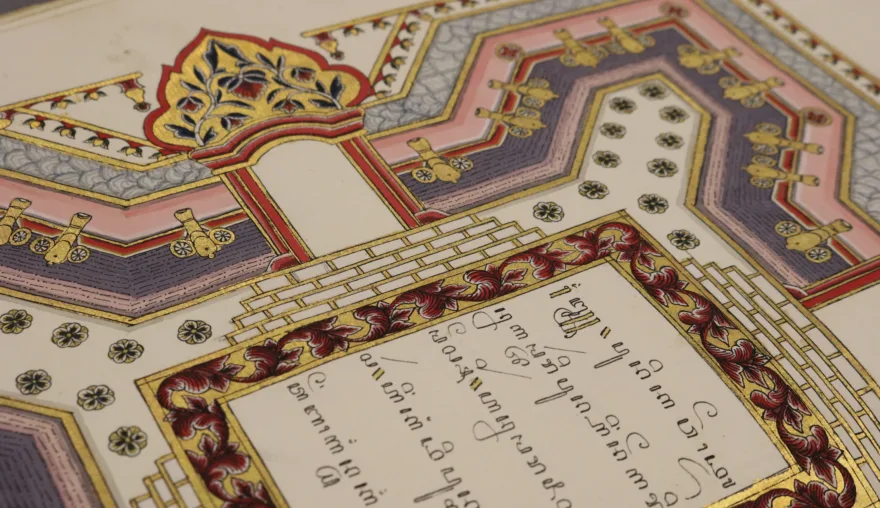
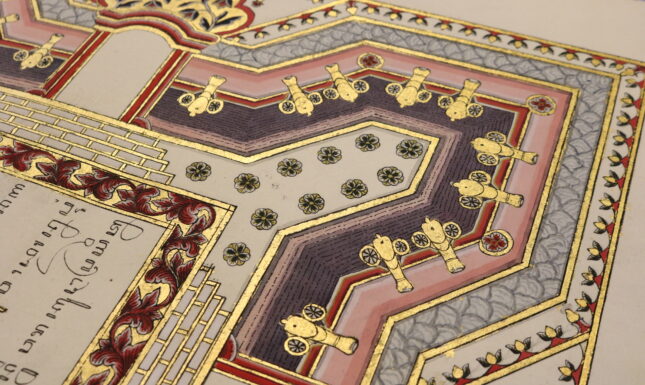
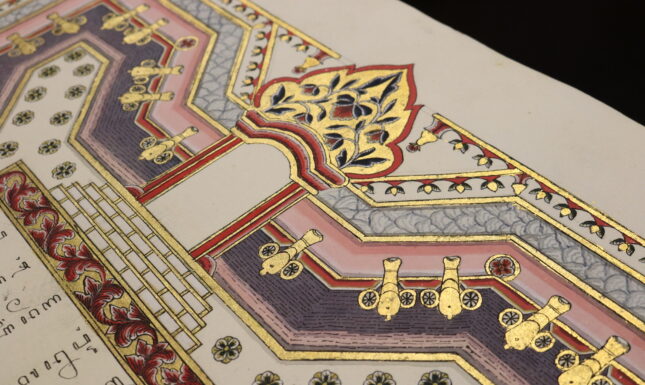
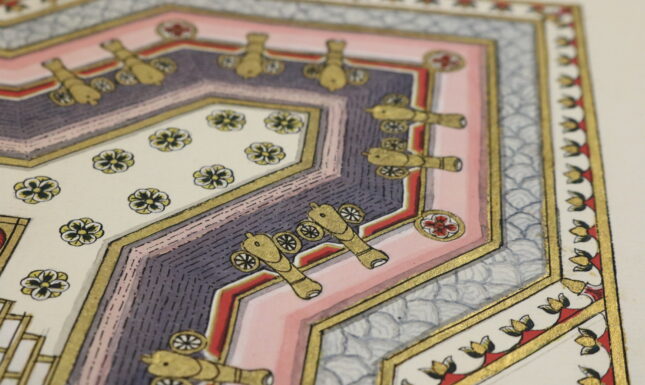
A text is enshrined within multiple layers of the walls and fences and surrounded by the towers of a fortress. No less than 40 cannons are pointing to the outside, ready to shoot at any possible intruder. Inside this fortress, the text in the innermost part is well defended.
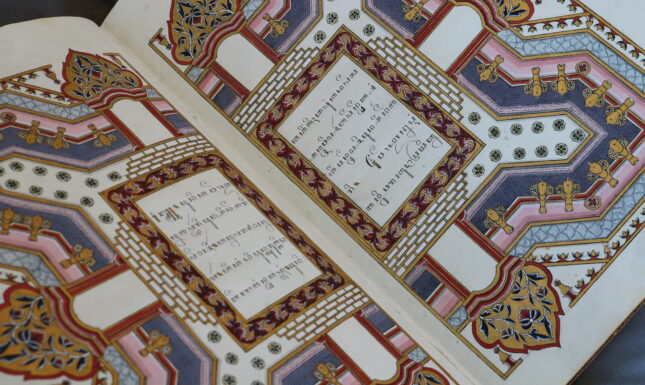
The walls and the text it encloses are an illumination in the Leiden manuscript D Or. 15 known as the Babad Paku Alaman (“The Chronicle of Paku Alaman”). This manuscript is a copy of the more ancient Babad Panjěngěnan (“The Chronicle of Reigns”) inscribed around 1800 at the royal scriptorium of Yogyakarta, Central Java. The Babad Panjěngěnan is a manuscript known as pusaka, a sacred heirloom that transports the knowledge and power of previous generations to the present and the future. Pusaka are by definition not for the public. Instead, their potency was contingent on being reserved for special people like rulers, who could match and channel the heirloom’s power. The relation between a pusaka and its owner is thus reciprocal. While the owner shields the pusaka from other people accessing it, making it public and hence less powerful, the pusaka fortifies and consolidates the strength of the already powerful owner. The illumination enclosing the text (wědana rěnggan) embodies a similar reciprocal dynamic. The fortress represents the abode of a ruler, who protects the powerful truths the text communicates. As a result, he is further strengthened in his position.
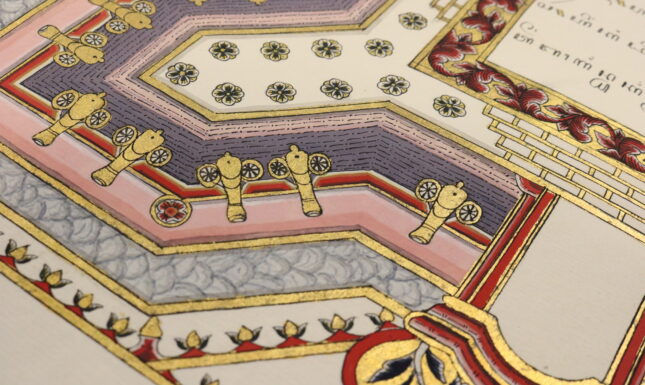
But the connection between text and illustration is not as straightforward as it first seems, also troubling the simple reciprocity between pusaka and owner. The text that is protected by the walls belongs to the well-known genre of the Menak, stories of Amir Hamzah, the Prophet’s uncle, whose exploits were turned into epics in literary traditions from Persia to Java. As we learn on this page, a fortress is breached by Amir Hamzah as he defeats King Sanasar, a mythical king of Egypt — and yet, the wědana rěnggan representing the fortress, as well as the text inside, are pictured in their intact form.
A pusaka was not destroyed if it was seized by someone else, as long as its new owner also granted it protection and exclusivity. Enclosed by a new fortress, the pusaka would then fortify its new owner. In the traditional political thought and practice of the Malay-Indonesian world, the appropriation of a sacred heirloom would be both the cause and an expression of a former ruler’s loss of power and the ascendency of a new king. Whatever power and knowledge King Sanasar may have had, Amir Hamzah, with his victorious military might, has seized it and integrated it into the spiritual power of Islam from which his own power is derived.
The historical trajectory of both the Babad Panjěněngan and its copy D Or. 15 also present us with stories of breached fortresses and new owners. The Babad Panjěněngan is attested for the first time in 1812, when Stamford Raffles invaded the royal palace (kraton) in Yogyakarta. Sultan Hamengkubuwana II and his family were taken prisoner and all his belongings — including his library — were picked over and taken by the British officials in command of the attack. The Babad Panjěněngan, too, was examined by Raffles, but rather than taking it himself, he gifted it to Hamengkubuwana II’s half-brother and rival Paku Alam, who had supported the British in their campaign. But the British favors did not end with this gift. Raffles also facilitated the foundation of the Paku Alaman duchy, likewise based in Yogyakarta. Owning the Babad Panjěněngan entailed a claim to legitimate stewardship of the power and knowledge it transmitted, like the walls of the Paku Alaman court now enclosed the physical manuscript.
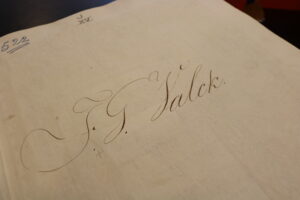
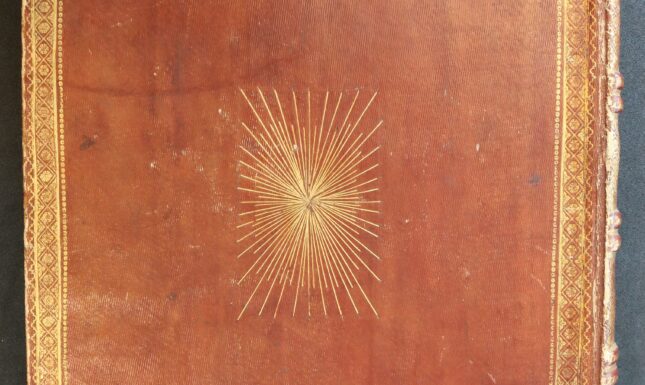
At the Paku Alaman court, the Babad Panjěněngan continued to play a political role throughout the nineteenth century. In accounts written by officials from overseas visiting the court, we learn that a typical welcoming ceremony featured a display of this same manuscript. One of these visitors was the Dutch Prince Hendrik de Zeevaarder (1820-1879), who travelled in the Dutch East Indies from 1836 to 1838. In the company of Frans G. Valck, the Resident (Regional Governor) of Yogyakarta (1831-1841), he was received by the Paku Alaman court in July 1837. Valck, a hobby archaeologist and ardent collector of ancient Javanese art, owned a copy of the Babad Panjěněngan, and at some point after Hendrik’s visit to Yogyakarta, Valck’s copy wound up in the prince’s possessions. After Hendrik’s death in 1879, the manuscript was purchased by the Royal Netherlands Institute of Southeast Asian and Caribbean Studies (KITLV) and renamed as the Babad Paku Alaman. It has remained in the KITLV collections, which are now managed as part of the Special Collections of Leiden University Library.
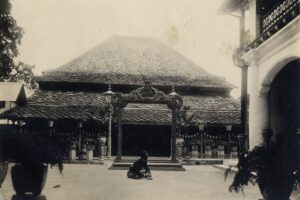
The trajectories of the original pusaka and its Leiden copy both reinforce and complicate the notion of the impenetrable fortress. In the story narrated in the manuscript, the knowledge and powers of the text are claimed on behalf of Amir Hamzah, through whose military might they were appropriated from a fortress Hamzah besieged. In the historical life of the Babad Panjěněngan, the kraton’s loss of stewardship over the manuscript and its transfer to the newly founded Paku Alaman court both generate and reflect the kraton’s weakened status in the political landscape of colonial Java while strengthening the position of the new duchy. At the Paku Alaman court, the manuscript was exhibited during diplomatic ceremonies and copied for colonial officials like Valck, likely to foster good relationships and gain political favors.
The library stands at the end of this trajectory as an institution whose authority is likewise built on the safeguarding of knowledge. As a kind of fortress in its own right, the library is faced with difficult questions about for whom this knowledge is intended, and to whom it is accountable. Is access a good thing when the original manuscript was only intended for the eyes of very few? And who gets to decide? Taking into account these troubled histories will give us no easy answers to these questions. But it helps us understand the political stakes involved in how we approach our collections.
About the author:
Verena Meyer is Assistant professor of Islam in South and Southeast Asia at the Leiden Institute for Area Studies. She is currently working on a NWO funded project on the political and cultural effects of digitisation. Her book Theologies of remembering: Modernity, Ambiguity and Transcendence in Islamic Indonesia (University of California Press) has just appeared in Open Access and can be freely consulted here.
Research for this blog post was conducted in the context of the research project Unpacking the KITLV Collections.
Further reading:
Ardiyansyah, Panggah, and Verena Meyer. 2025. “From Raids to Digital Returns: The (Im-)materiality of Manuscripts in Decolonizing Heritage Practices.” Archipel 110: 337–59.
Behrend, Timothy E. 2025. “Literary Magic and Dynastic Identity in a Pakualaman Court Text: Locating Kangjeng Kiyai Jatipusaka in the Realm of Yogyakarta Literature.” In Dari Bagendha Kilir Sampai Ke Pujanggestri: Bunga Rampai Persembahan Untuk Dr. Sri Ratna Saktimulya, edited by Rudy Wiratama, 5–172. Yogyakarta: Gadjah Mada University Press.
Carey, Peter. 1992. The British in Java, 1811-1816. Oxford: The British Academy, by Oxford University Press.
Drieënhuizen, Caroline A. 2011. “De Kunst Van Het Verzamelen: Koloniale Verzamelaars En De Wak.” Aziatische Kunst 41 (3): 2–15.
Florida, Nancy. 1995. Writing the Past, Inscribing the Future: History as Prophecy in Colonial Java. Durham: Duke University Press.
Huyssen van Kattendyke, W.C.J. 2004. Met Prins Hendrik Naar De Oost: De Reis Van W.J.C. Huyssen Van Kattendijke Naar Nederlands-Indië, 1836-1838. Zutphen: Walburg Pers.
Saktimulya, Sri Ratna. 2016. Naskah-Naskah Skriptorium Pakualaman: Periode Paku Alam Ii (1830-1858). Jakarta: Kepustakaan Populer Gramedia.