


Gone is different from dead
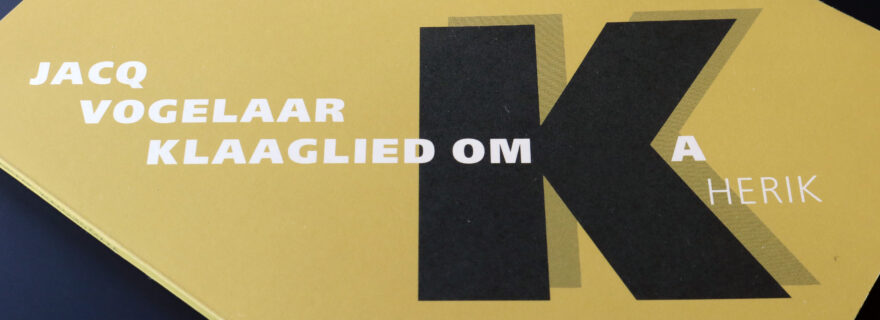
In 1997, Jacq Vogelaar—who was mainly known as an experimental prose writer and as a literary critic—published a poetry collection for the first time in over thirty years: Klaaglied om Ka, which was released as a bibliophile edition with notable illustrations. What prompted this poetic comeback?
‘Jacq, you’re also a father, besides being a writer, right? You have a daughter.’ In a 1996 radio interview, journalist Martin Šimek asks Jacq Vogelaar (1944–2013) this question in his typical, quasi-naive and disarming style. The latter’s understated response immediately reveals something about the sensitive private territory the conversation is moving toward: ‘Yes, whether that makes me a father… Nominally, yes.’
It turns out that Vogelaar no longer sees his daughter, as Šimek’s further questioning reveals. The reasons for this remain unclear, partly because Vogelaar chooses not to speak publicly about this personal matter. ‘But there are also some things I don’t know. (...) I could say: I had a daughter. But you can’t speak of that in the past tense. You also can’t say: I had parents. You have them, even if they’re dead, or have emigrated. Some things you keep.” Prompted by that last line, Šimek—whether deliberately or inadvertently taking ‘keep’ in the emotional sense of keeping in one’s heart—asks whether Vogelaar loves his daughter. ‘Well, I actually meant a different kind of ‘keeping’, but of course that’s related. Yes, I don’t know. You can’t say that about someone who isn’t there.’
As cerebral and detached as that may sound, Vogelaar does indeed feel the loss intensely. A year after this interview, his processing of this experience takes on a public and literary form when he publishes a cycle of thirteen poems in which loss and absence inexorably set the tone: Klaaglied om Ka (Elegy for Ka, 1997). This is his first collection of poetry since his 1965 debut with the experimental collection parterre, en van glas, though that does not mean Vogelaar was entirely inactive as a poet during the intervening three decades.
Perhaps just as remarkable as his return to poetry was the barely concealed autobiographical theme of the collection. In Vogelaar’s literary work up to that point, there had been little directly personal subject matter: his work focused more on exploring new forms and possibilities in literature than on expressing experiences that could be clearly traced back to his own life. In Klaaglied om Ka, this is different, and the author’s personal experience lies like an exposed nerve on the surface of the poems.
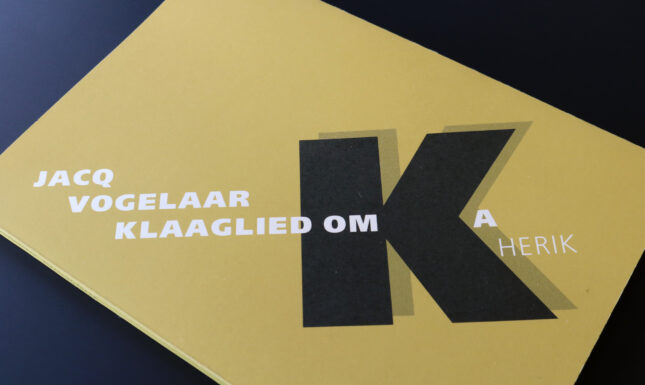
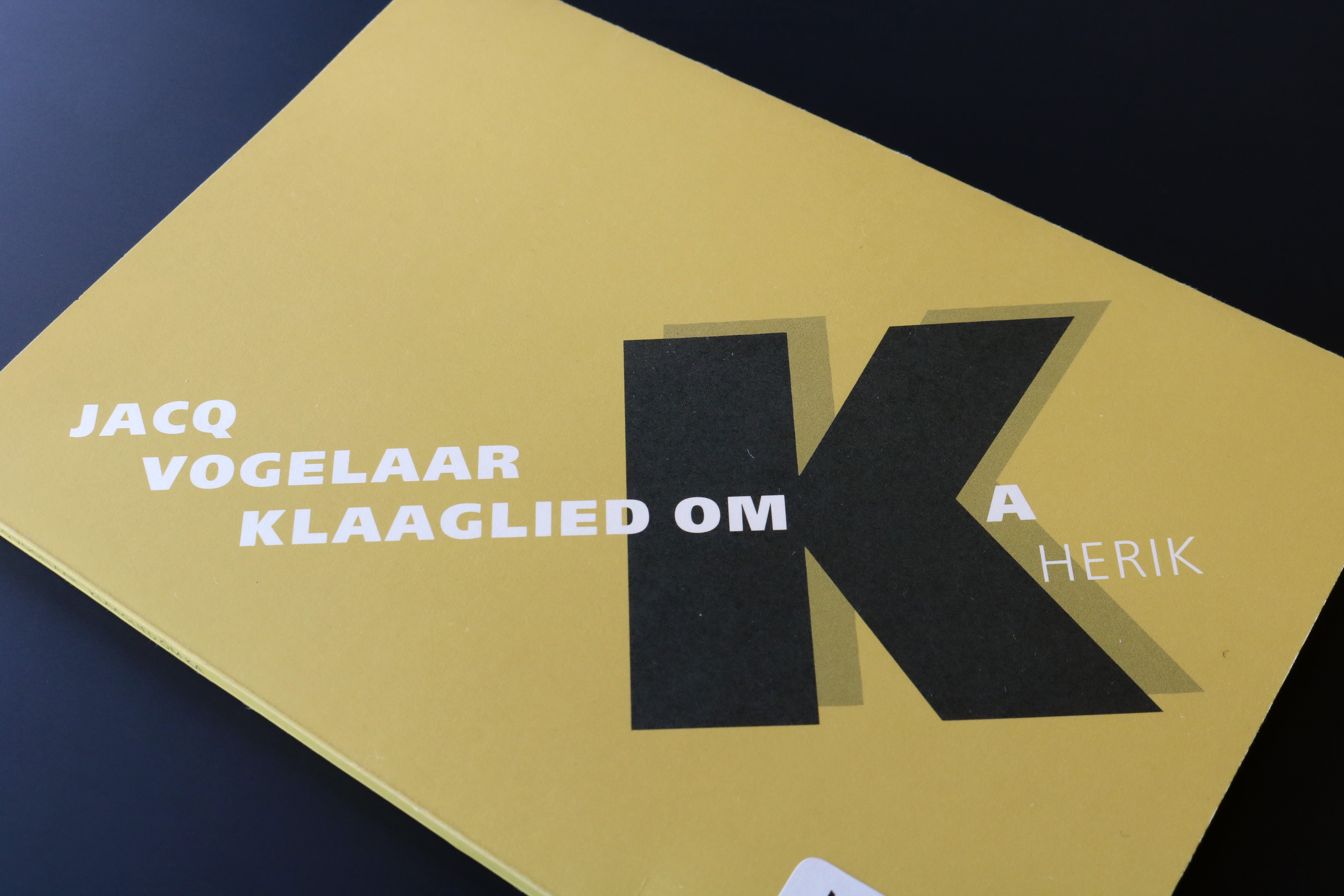
Klaaglied om Ka opens with a motto by the Argentine writer Jorge Luis Borges (1899–1986) on the Egyptian belief in the figure of Ka as the exact double of all beings—humans, animals, plants, objects, gods—who was visible only to certain priests. The cycle of thirteen poems that follows this motto is divided into three parts: ‘In the Name of the Name,’ ‘In the Sign of the Stone,’ and ‘The Wrong House.’ Ka appears in all three parts, each time as an emblem of absence, or as the presence of the absent.
It doesn’t take much prior biographical knowledge to link the character of Ka to the daughter who disappeared from Vogelaar’s life, who was born as Klara. Readers of Vogelaar’s only children’s book, Het geheim van de bolhoeden (The Secret of the Bowlers Hats, 1986), may recall that this book was dedicated to ‘Klara’ and that the back cover features a vacation photo of father and daughter in seemingly happier times. The first part of the cycle opens with several poems about the father-daughter relationship, providing a concrete relational framework for the themes of absence and loss that are maintained throughout the rest of the collection.
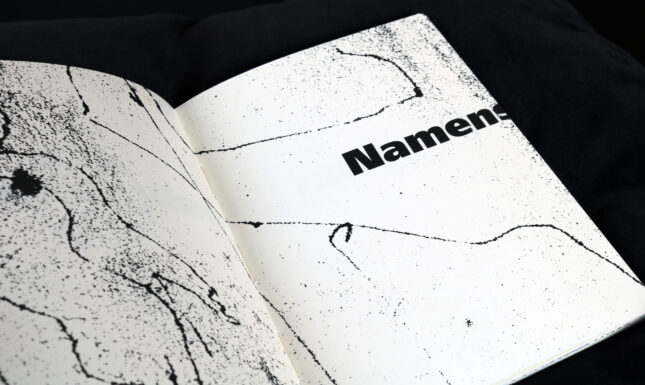
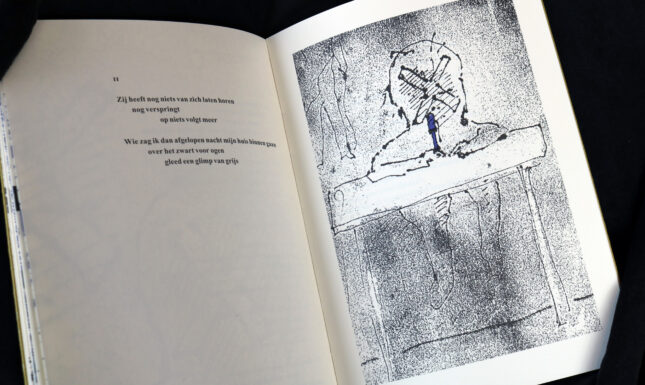
In addition to thirteen poems, the collection also includes a drawing by painter, illustrator, and artist Co Westerik (1924–2018), Het afgekruiste kind (The Crossed-Out Child), and ten reworkings of Westerik’s drawing by graphic designer Kees Nieuwenhuijzen (1933–2017), scattered throughout the collection. Vogelaar was in familiar company with them: Nieuwenhuijzen had been a designer (and later also an editor) of the literary magazine Raster—which focused on international and experimental literature—since its founding, and Vogelaar served as a highly productive and passionate editor of the magazine from 1977 until its discontinuation in 2008. In 1995, Raster devoted extensive attention to Westerik’s work, including a series of short prose pieces by Vogelaar inspired by his drawings. Westerik’s work already possessed a certain literary allure in its own right, both due to the narrative suggestions evoked by his images and because of the often poetic titles he used, with Snijden aan gras (Cutting at Grass) as the best-known example.
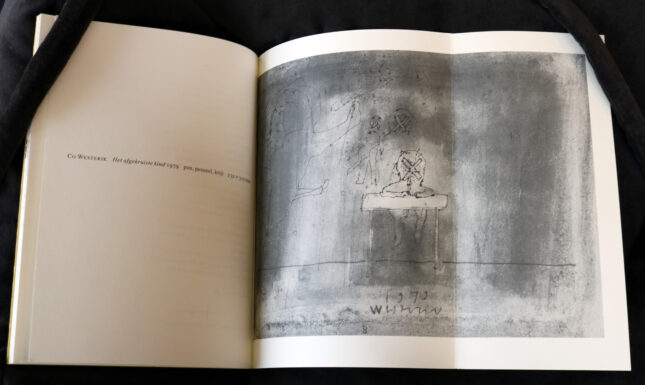
The choice of Het afgekruiste kind for Vogelaar’s poems, however, reveals more than just artistic affinity. For the child in this 1979 drawing, Westerik drew inspiration from his daughter Christine, who died in 1992 after what Westerik described as an “absolutely shitty life” marked by substance abuse and mental health issues. Westerik compares the X-shaped cross he has drawn over the child’s face in this drawing to a cross placed on a tree marked for felling. Even though the circumstances are different in nature, Westerik’s drawing and Vogelaar’s poems express similar personal experiences.
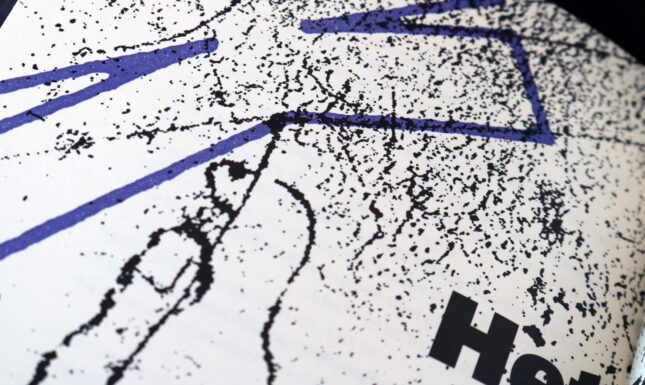
Nieuwenhuijzen’s image manipulations magnify various details of Westerik’s drawing and add a purple hue to them. As a result, these images function as repetitions and variations of Westerik’s drawing, just as repetition is an important organizing principle of this collection. This is evident primarily in the repetition of sounds and words and the use of the doppelgänger motif borrowed from Egyptian mythology, but also, for example, in the reuse of the title of Vogelaar’s debut collection for one of the thirteen poems. The cross from Westerik’s drawing and the letter K from Ka (and Klara) also form variations on one another in Nieuwenhuijzen’s adaptation.
The element of repetition is also essential to the distinction made in this collection between the absence of death and that of a disappearance:
Gone is different from dead
not itself
it is and it is once again
deathless
each time again
each time different
Compared to death, disappearance adds the experience of repetition and variation, whereby the ‘deathless’ emphasizes the impossibility of a definitive and irreversible form of closure. The thirteen poems—no accidental number—thus each express a different facet of the same loss and read as variations on the single elegy that forms the title of the collection.
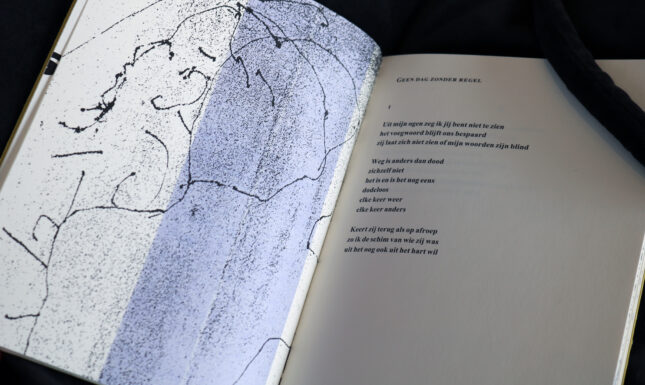
Klaaglied om Ka is a remarkable work within Vogelaar’s oeuvre for several reasons. Autobiographical themes are nowhere else in his earlier or later work so poignant and so directly present. In addition, Westerik’s drawings and Nieuwenhuijzen’s reworkings add a powerful visual dimension to the cycle, one that would be missing from the republication of most of these poems in Vogelaar’s final poetry collection, Inktvraat (Ink Corrosion, 1998). Finally, the decision to publish a bibliophile, numbered, and signed edition through the small Limburg publishing house Herik makes this collection an exception among Vogelaar’s books, virtually all of which were published by major Amsterdam publishers.
Although a print run of two editions of 299 copies each is hardly what one would call exclusive for a poetry collection, it is likely that these poems never reached the one reader Vogelaar intended to reach. Who else but his daughter could he have had in mind with a line such as ‘written remains unread’? In a 2007 interview, a few years before his death, Vogelaar confirms that she is still absent from his life, has taken on a different name, and that the exact circumstances remain a mystery to him: ‘There is always a little rat in the cage of my head, gnawing at the bars.’ Playing Orpheus, as he bitterly ironizes the role of the poet in Klaaglied om Ka, has not managed to bring back a beloved for Vogelaar either. What remains is the loss: ‘These words are nothing more than shards.’
Authors
Fyke Goorden works as a civil servant in The Hague. He has published several articles on Jacq Vogelaar’s life and work in preparation for his biography.
Tommy van Avermaete works at Leiden University Library as a subject librarian. He is an editor for the literary platform Pas Uit (pasuit.nl) and The Dutch Review of Books. Together with Fyke Goorden, he is working on a biography of Jacq Vogelaar. He is the editor of Door de schaduwen bestormd (Besieged by the shadows, 2019), about the controversy surrounding the poet Lucebert’s wartime past, and Schrijven over vernietiging (Writing about destruction, 2025), about literature from concentration camps. He regularly publishes essays in literary journals.