The ‘East Indies Conan Doyle’: censored passages from Ucee’s Indo-detective resurface

Between 1924 and 1931, a certain Ucee published a five-part ‘Indo-detective’ series, following the Eurasian sleuth Leo Brandhorst. A newly donated ultra-rare first edition reveals censored passages cut from later reprints, exposing social tensions and everyday racism in the former Dutch East Indies.
To this day, little is known about the man behind the pseudonym. Ulrich Coldenhoff (1890-1963) was born on 15 February 1890 in Meester Cornelis (present-day Jatinegara) and worked for two years at the Post and Telegraph Service before entering the service of the KPM, the Royal Packet Navigation Company. In 1918 he married Stephanie Albertine Blok (1890-1962) in Batavia (now Jakarta). The couple later moved to Zwollekerspel in the Netherlands, where they died shortly after one another. Beyond these bare facts, his life remains undocumented. What is certain is that Coldenhoff knew colonial society from within.
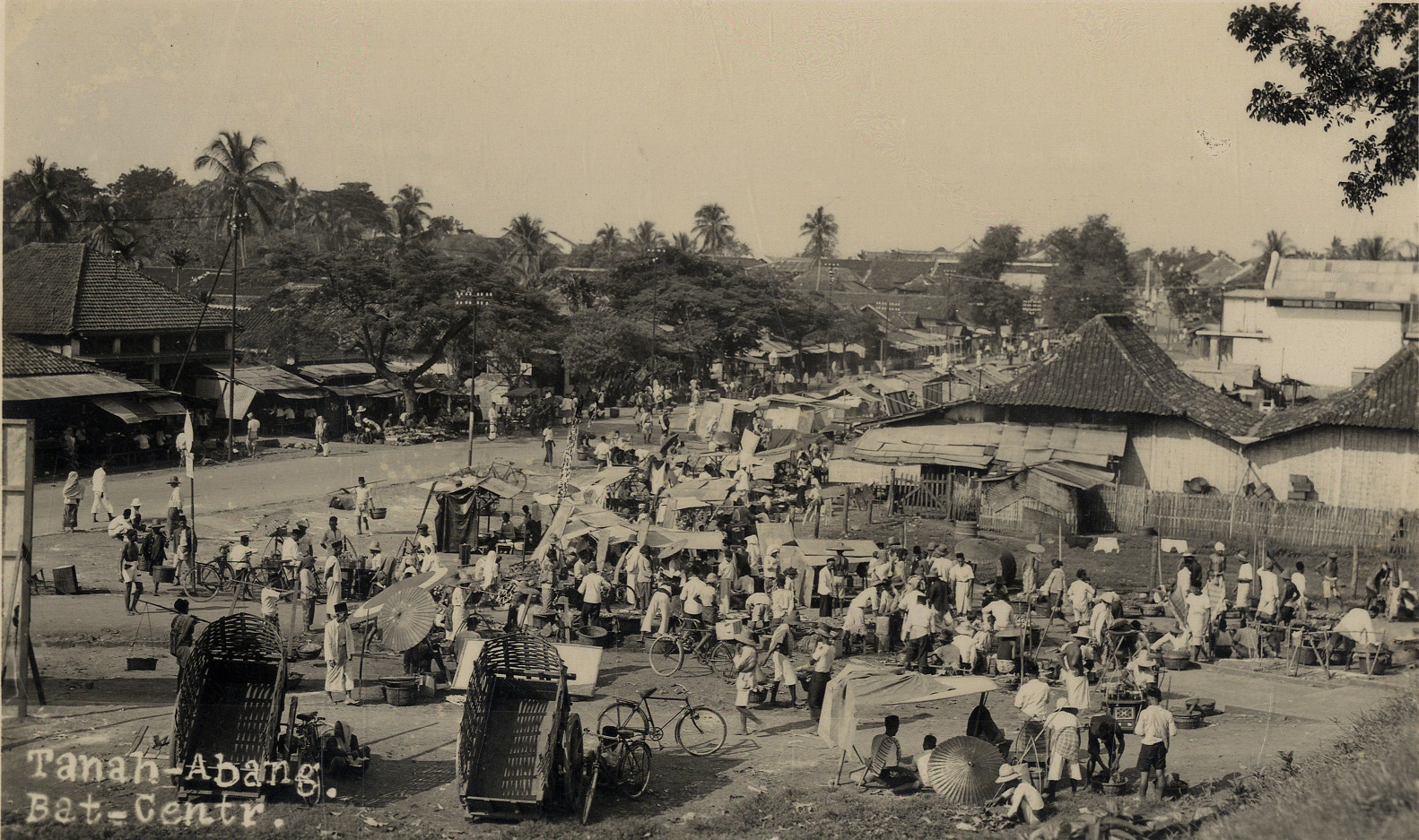
That intimate familiarity became the strength of Ucee’s Indo-detective series. In the first of five volumes, De schoonste triomf van den Indo-detective (The Finest Triumph of the Indo-Detective; 1924), Ucee introduces his protagonist: Leo Brandhorst, an ‘Indo’ (short for Indo-European; Eurasian) living in a small bamboo house on the edge of Tanah Abang. After office hours he devours detective novels, and this bookish training, combined with quick wit and steady nerve, soon draws him into assisting the local police. His hybrid position gives him access to multiple layers of colonial society but also makes him a target. Gangs of local robbers pursue him, while within the police ranks he faces outspoken ‘Indo-haters’. Fortunately, two loyal companions stand by his side: Dutchman Kees van Berg and the Ambonese clerk Willem ‘Tjeroeroet’ (house shrew) Sopamena. Their interplay offers a revealing glimpse into the tensions and hierarchies of colonial society, showing just how intricate and ambivalent these structures could be.
This quality was recognised by Jan Boon (1911-1974), who achieved renown under the pseudonym Tjalie Robinson as a writer of sketches of colonial life and as founder of the Indo-oriented platform Tong Tong, later renamed Moesson. Captivated by the series, he decided to republish Ucee’s long-scarce debut in 1962; a further reprint followed in 1986. For Boon, the novel’s merit lay not in intricate plotting, but somewhere else: it offered ‘East Indies life itself, so Europeans, Indonesians, Chinese and Arabs in a colourful mixture of remarkable encounters and conflicts, all drawn with a perhaps entirely unintended, yet therefore all the more valuable authenticity.’ As a chronicler of colonial life, Tjalie Robinson had found in Ucee a kindred spirit.
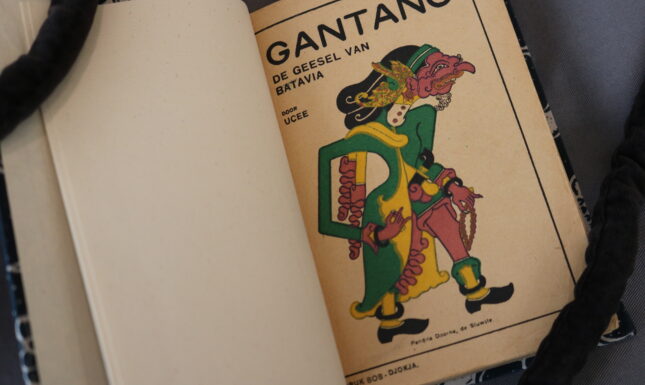
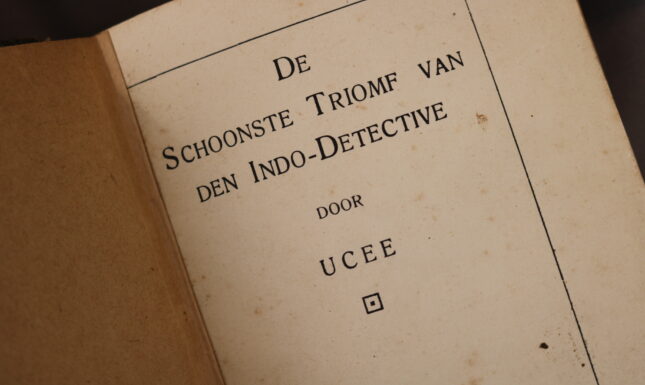
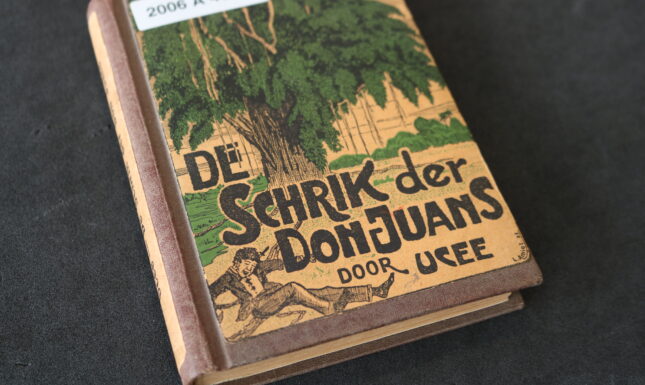
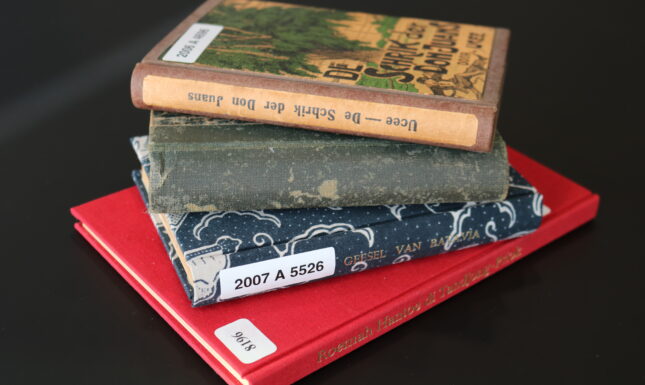
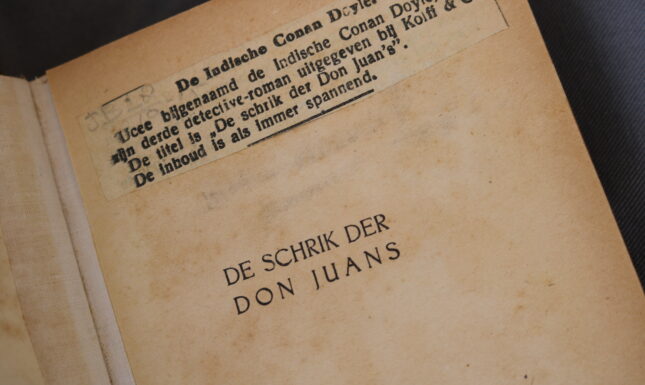
An extremely rare copy of the first edition was recently donated to the Leiden University Libraries by detective connoisseur Kees de Leeuw, author of the only comprehensive study of Dutch (post)colonial crime novels to date, Goena goena en slinkse wegen (2008). The library now holds the only known copy in a public collection. The century-old volume turned out to contain a few striking surprises. In Boon’s later reprints, Brandhorst abruptly leaves a masked ball and exits the scene. In Ucee’s original, however, he is first drawn into a confrontation with three Dutch ‘race-haters’. Taunted and insulted, he and Kees swiftly take down the attackers using the Indonesian martial art pukulan. This entire four-page episode was excised by Boon from all reprints, along with several smaller cuts. Likewise, the once common colonial term inlander, roughly equivalent to ‘native’, was systematically removed. Such interventions are, in a sense, understandable. By the 1960s colonial vocabulary had become heavily charged, and although Brandhorst and his companion clearly occupy the moral high ground, an unvarnished fistfight reinforced persistent stereotypes of Indo’s as hot-blooded. Yet Boon’s editorial hand erased one of the most revealing dimensions of Ucee’s prose: the language and omitted scene lay bare racial antagonisms simmering beneath the surface of colonial society.
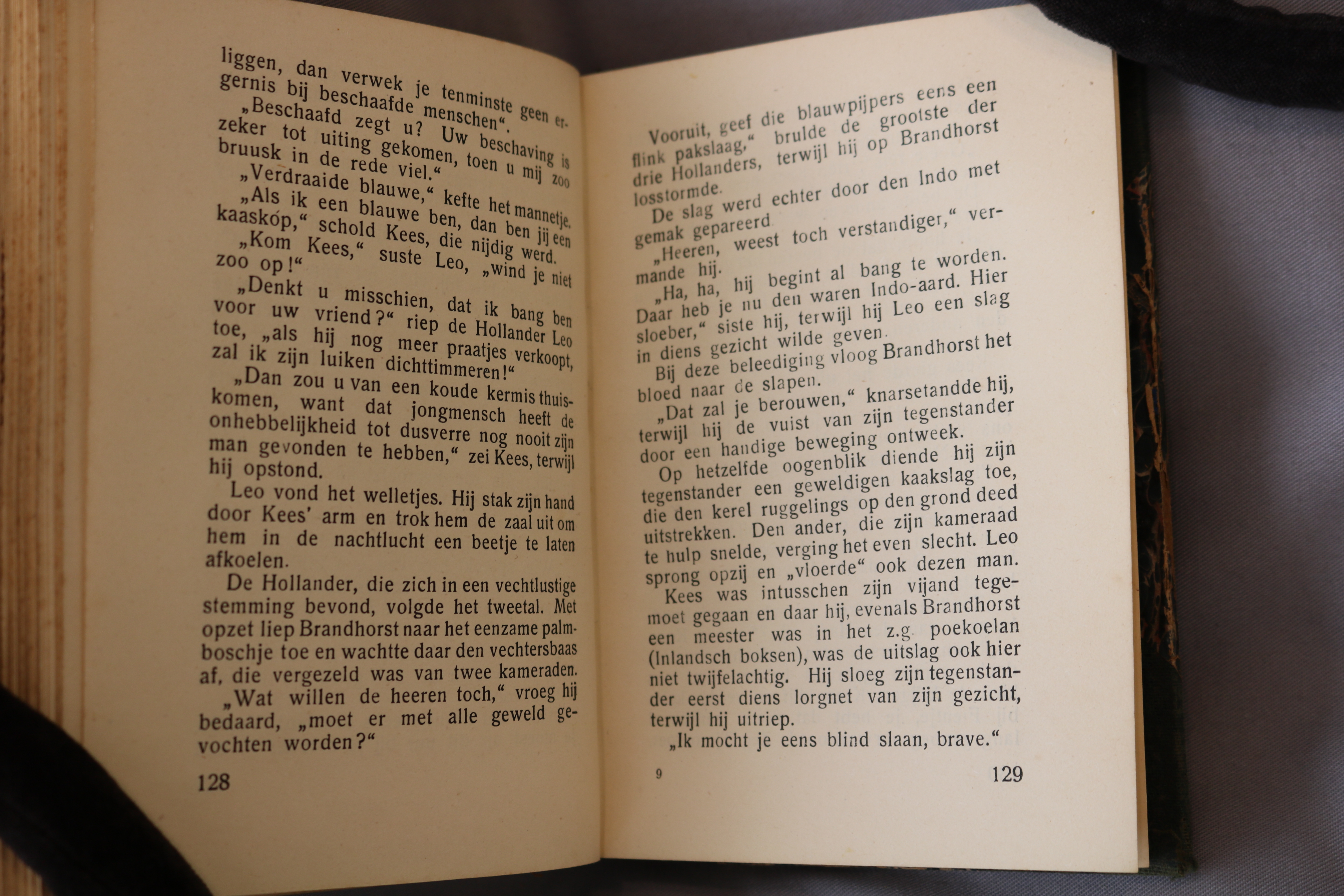
Racism towards Eurasians was widespread in Ucee’s day. People of mixed European and Asian descent were found in every stratum of colonial society, from the elite to the slums. Those acknowledged by a European father were legally classified as European; others were assigned to the Indigenous population. Under the influence of nineteenth-century ideas about ‘race’ and ‘racial mixing’, however, Eurasians increasingly came to be regarded as a separate category, with structural discrimination as a result. In response, organisations such as the Indische Bond and figures like journalist Karel Zaalberg (1873-1928) began advocating for Eurasian interests. By the 1920s, writers and intellectuals increasingly championed the Eurasian cause and pushed back against ‘Indo-haters’. Ucee’s Indo-detective novels fit within this emancipatory current. The recovered passage makes this explicit: Brandhorst quite literally fights back against racial hatred.
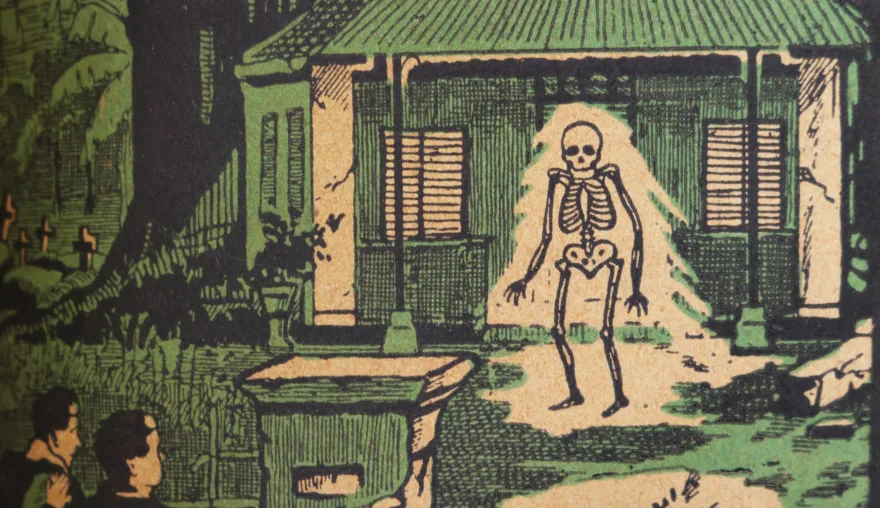
Leiden University Library holds several other exceedingly rare volumes from the series, including the popular third instalment, De schrik der Don Juans (The Terror of the Don Juans; 1925), and a Malay translation of the second volume, Roemah Hantoe di Tandjong-Priok (The Haunted House of Tandjong Priok; 1925). In addition, the library preserves Gantang (1931), the final adventure in the series, which is also absent from all other major library collections in the Netherlands.
Despite his nickname in the press, Ucee was no Arthur Conan Doyle. He did not craft intricately plotted ‘whodunits’, but rather rambling and occasionally incoherent thrillers. Yet his characters are vividly drawn, the Malay-inflected dialogues ring with authenticity, and his evocation of colonial society in the 1920s is exceptionally colourful. As the first detective writer of the Dutch East Indies and a chronicler of the social tensions that gripped the colony in his day, Ucee unquestionably deserves renewed - and uncensored - attention.
About the author:
Goran Bouaziz MA is a PhD candidate and lecturer in modern Dutch literature at Leiden University. His research centers on Dutch-language theatrical texts between 1900 and 1940, with secondary interests in (post)colonial literature, modernist prose and crime fiction. He is an editor of the academic journal Indische Letteren.