Two 17th century Chinese-Portuguese dictionaries digitized

The Leiden Library Asian Collection hosts, under the shelfmarks Or. 1929 a and Or. 1929 b two Chinese Portuguese dictionaries. These have now been made available in digital form. María Teresa González Linaje explains what they teach us about the early linguistic contacts between China and the West.
Time is not kind to manuscripts which suffer the vicissitudes of climate and history and get lost or damaged. These rare handwritten dictionaries are important witnesses to the early contacts between China and Europe.
Vocabularies like these were often created by missionaries to proselytize not only in China, but also in the Philippines, then part of the Spanish Empire, where a large Chinese community (Sangley) lived. Nevertheless, at the end of the 16th century, Portuguese was widely used in the region, because Portugal had successfully established a trading post in Macao (Aomen 澳門) by 1577. Macao played a key role in exchange between East West and facilitated the return of China on the international stage.
Missionaries were responsible for almost all the handwritten dictionaries from the 16th to the 18th centuries of Mandarin Chinese (Guanhua 官話) plus southern Chinese languages (Hokkien 福建話 or Southern Min 閩南語) for European users.
For this production the support of Chinese assistants was often essential, to compensate for insufficient writing and reading skills of the authors. The most iconic dictionaries circulated not only in China and the Philippines, but also found their way to European libraries. The Leiden volumes are peculiar because of their European paper and binding.
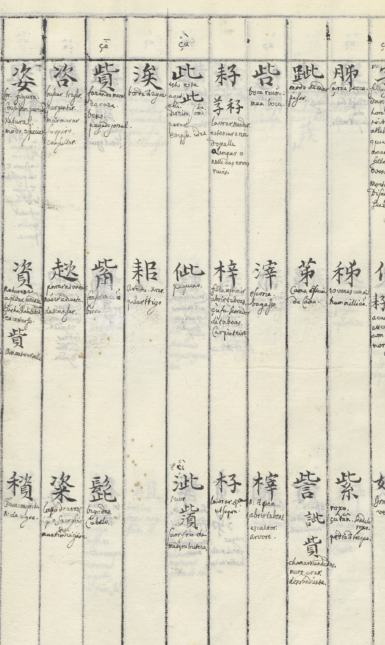
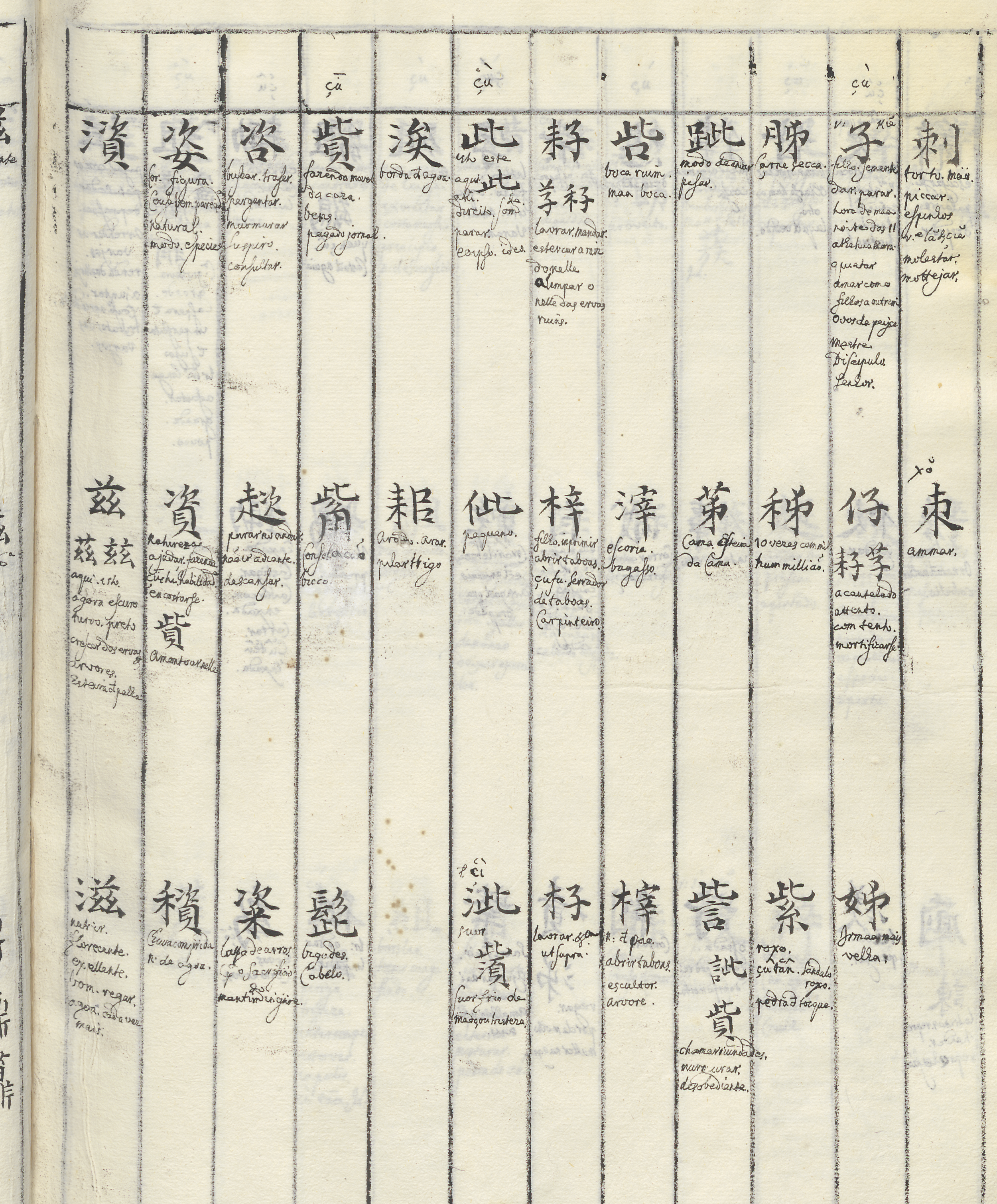
Both dictionaries (Or. 1929 a and Or. 1929 b) were part of the collection of books donated by Theodorus Sas, lawyer and former Councillor of Justice in Batavia, to Leiden Public Library in 1711. It is interesting to compare them with similar works, like the Chinese-Spanish dictionary by the Dominican Francisco Díaz (Su Fangji 蘇芳積 1606-1646), a copy of which is also available in the Leiden’s collection, and with works in the Vatican Library and in the Archivum Romanum Societatis Iesu (ARSI) in Rome. This Jesuit archive contains the oldest existing Portuguese-Chinese vocabulary, to which contributed, amongst others, the famous Italian Jesuits Matteo Ricci (Li Madou 利瑪竇1552-1610) and Michele Ruggieri (Luo Mingjian 羅明堅 1543-1607).
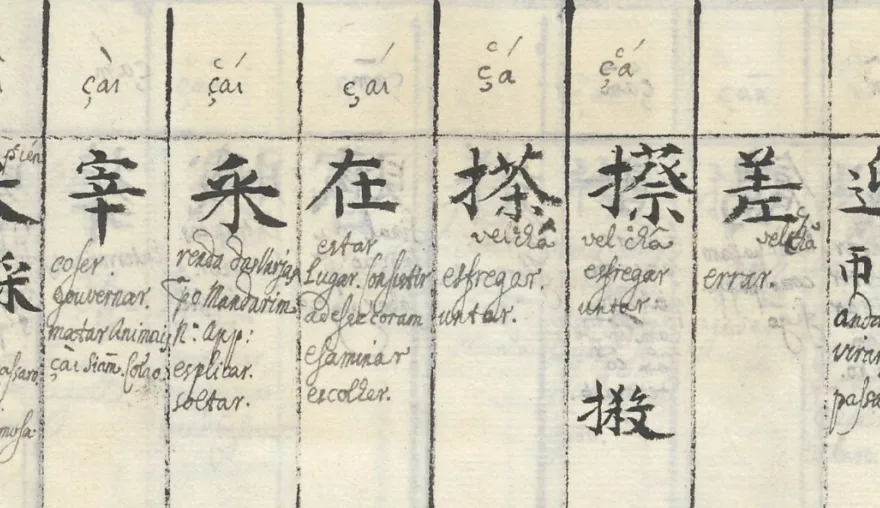
One of the characteristics of the anonymous Leiden volumes is their Chinese style, starting from back to front, using vertical columns that can be read from right to left. The design of these dictionaries differs from the patterns of the aforementioned Francisco Díaz and from the famous Chinese-Latin dictionaries of the Franciscan Basilio Brollo (Ye Zunxiao 葉尊孝 1648-1704), also known as Basilio di Gemona. A unique feature of the Leiden volume Or. 1929a is its inscription on the cover with the pronunciation of the tones used in spoken Mandarin, articulated around the word yān 焉.
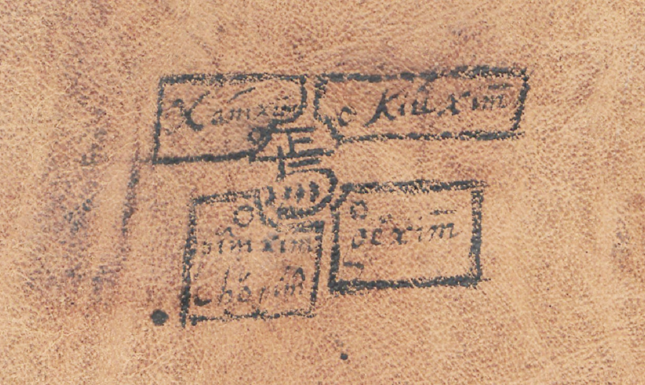
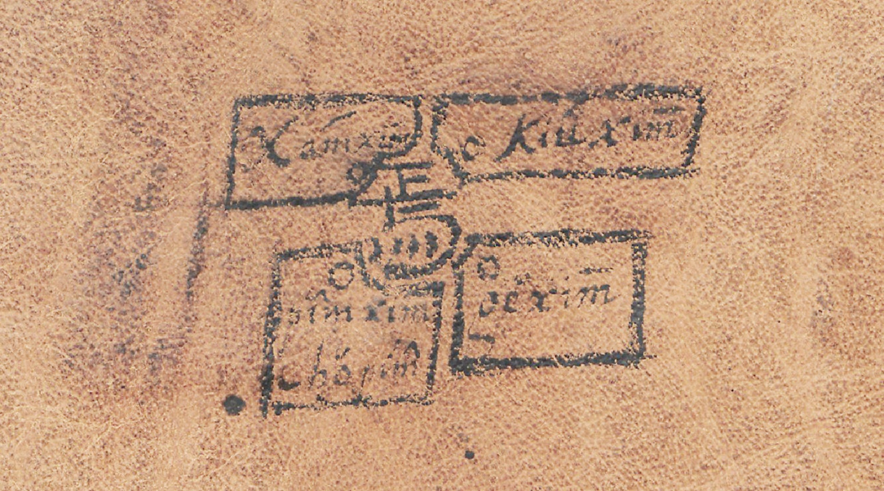
This brings us to the history of the Romanization of Chinese, which would soon be addressed by the Catholic orders in China and the Philippines with Ricci at the head, laying the foundations for the standardization of Chinese transliteration. This legacy continues to this day in the Latin-based Chinese Pinyin system for the alphabetic rendering of Mandarin and other Asian languages.
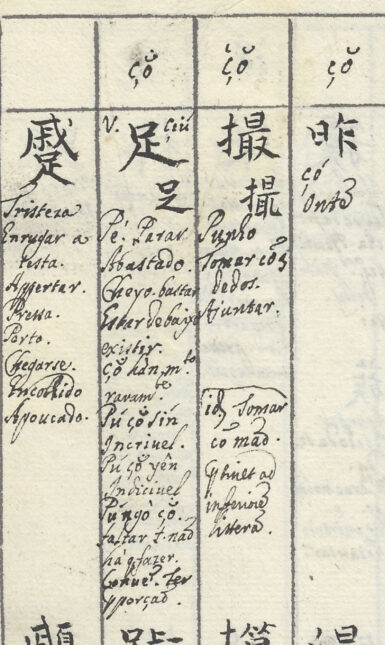
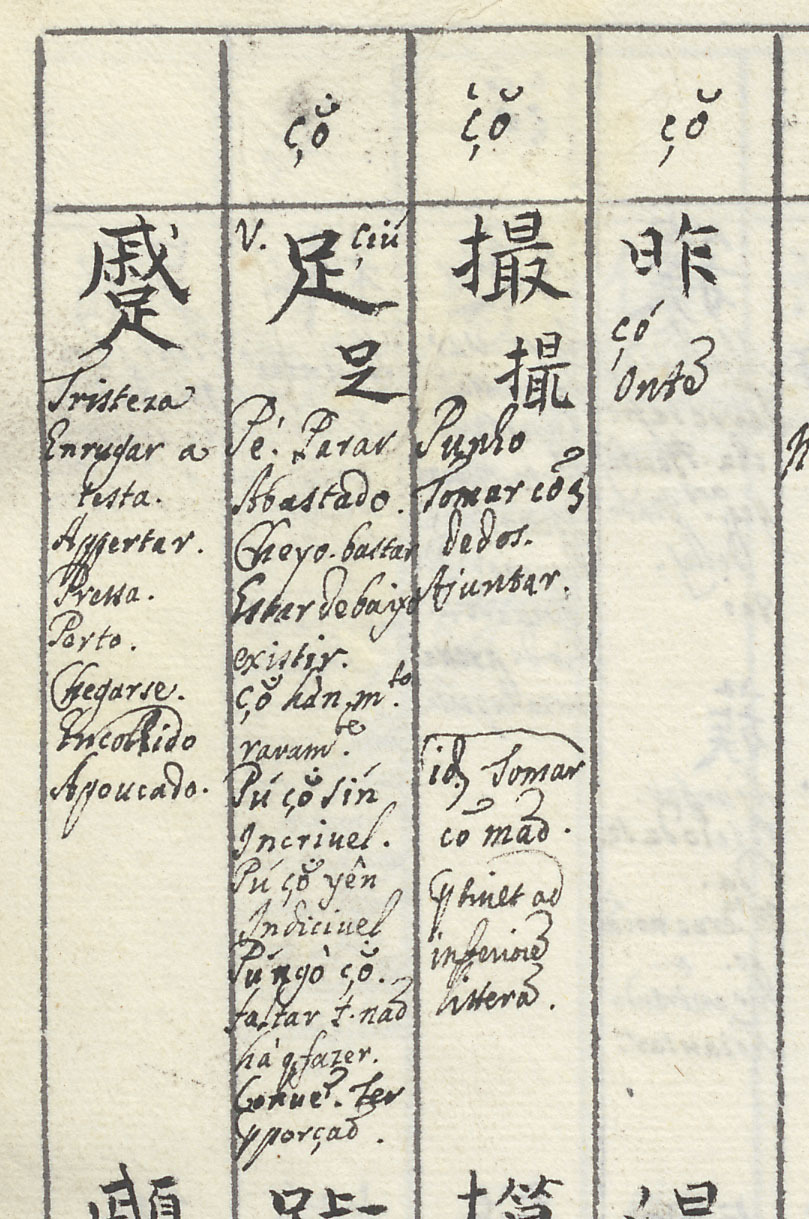
These volumes shed a precious light on the beginnings of Chinese linguistics in the West, allowing us to assess the understanding that early Western sinologists had of Chinese culture.
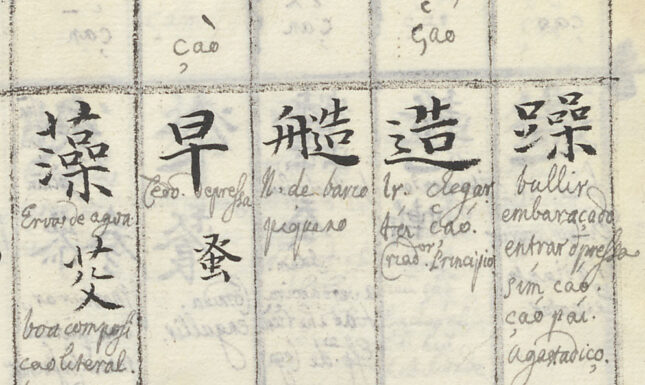
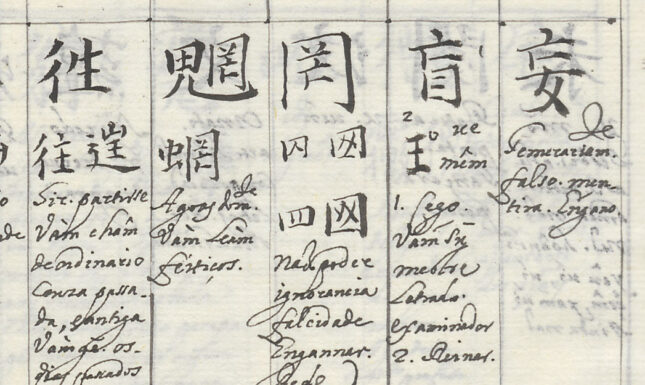
Different handwritings from the same dictionary. Leiden University Libraries, Or. 1929 a, fol. 156r and fol. 11v.
About the author
Dr. María Teresa (Maite) González Linaje is an independent scholar with the EFEO team in charge of the project ChEDiL ANR PRC directed by Dr. Michela Bussotti.
Further reading
Zwartjes, Otto. Missionary Grammars and Dictionaries of Chinese : The Contribution of Seventeenth Century Spanish Dominicans. John Benjamins Publishing Company, 2024.
Kuiper, Koos, et al. Catalogue of Chinese and Sino-Western Manuscripts in the Central Library of Leiden University. Universitaire Bibliotheken Leiden, 2016.
“Dictionnaires sino-européens. Manuscrits lexicographiques pour l'étude historique des échanges entre la Chine et l'Europe (fin du XVIe s.-début du XIXe s.)”. Accessed 7 July 2025.